



An Internationally Recognized Finnish Publication Examines the Link Between Reproduction and Biological Aging
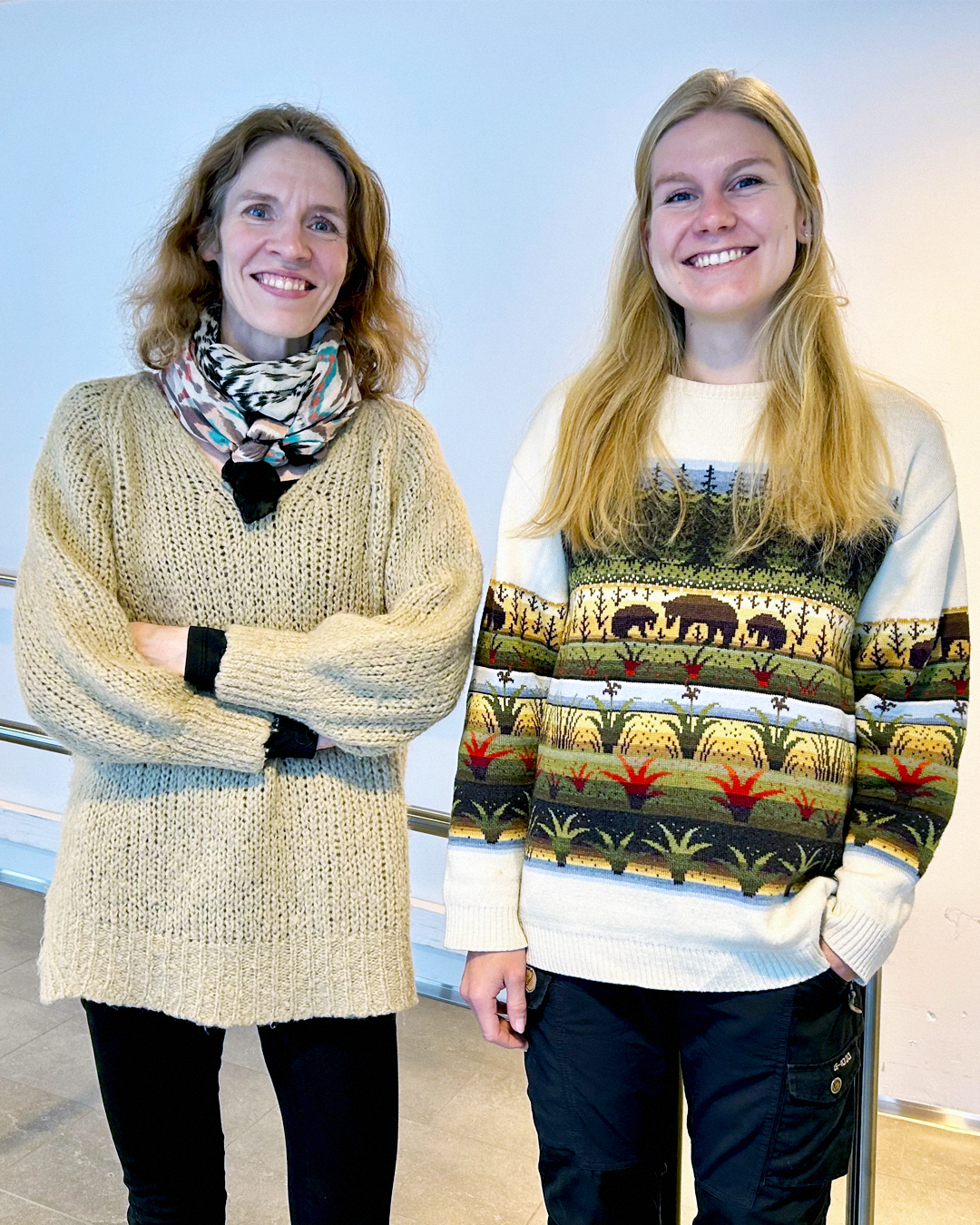
The epigenetic clocks used in the study are being studied by the Minerva Institute’s epigenomics research group. Pictured (left/right) are group leader, docent Miina Ollikainen and (left/right) research group member, doctoral researcher Mikaela Hukkanen.
A Finnish study published in early January in Nature Communications sheds light on the link between women’s reproductive history and biological aging. Nature Communications is one of the largest and most prestigious peer-reviewed journals in the field of natural sciences. Conducted using Finnish twin cohort data, the study shows that the number of births and the timing of pregnancies are connected to epigenetic aging and life expectancy.
The publication ‘Epigenetic aging and lifespan reflect reproductive history in the Finnish Twin Cohort’, authored by a research group consisting of members from University of Helsinki, University of Jyväskylä, and Minerva Foundation Institute for Medical Research, demonstrates that the number and timing of births are reflected in a woman’s biological aging and life expectancy. Its publication in Nature Communications has also brought the study significant media visibility both in Finland and abroad.
The publication is based on the doctoral dissertation findings of Mikaela Hukkanen, a researcher at the University of Helsinki and Minerva Institute, who held primary responsibility for conducting the study. In handling the research material and analyses, she was assisted by research colleagues, and in compiling the full dissertation, by her primary supervisor Miina Ollikainen, as well as supervisors Robin Cristofari and Jaakko Kaprio.
The study utilized the extensive Finnish Twin Cohort, where the life courses of participating women have been monitored from 1975 to the present day. The follow-up study is based on data from nearly 15,000 Finnish twin women born between 1880 and 1957. During the follow-up, data on reproductive history and lifestyle were collected, and dates of death were determined using records from the Digital and Population Data Services Agency in Finland. Additionally, blood samples were collected to determine epigenetic age. Based on this extensive monitoring, women with 2–3 children appear to live the longest. The timing of pregnancies is also significant; according to the study, women who had their children between the ages of approximately 24 and 38 aged the slowest.
Notably, a higher-than-average number of children (over 4) was found to be associated with a shorter lifespan and accelerated biological aging. According to the researchers, this observation aligns well with the evolutionary biological life history theory developed in the 20th century.
Research Inspired by the Animal Kingdom
Hukkanen has long been interested in evolutionary biology, particularly questions related to aging. As a result, the research topic was a clear choice, even though her previous subjects were from the animal world – primarily passerine birds and salmonids. In the next chapter of her dissertation, Hukkanen examines king penguins.
– I have always been fascinated by aging, and my previous research with animals inspired me to consider fundamental evolutionary questions in humans. I wanted to find out if a similar connection between reproduction and aging exists in modern humans. Natural selection favors reproduction, but according to evolutionary theory, this comes at the cost of lifespan. In this study, we investigated this ‘trade-off’ between resources by looking more broadly at the timing of all births for the first time, not just the total number. The comprehensive twin dataset also made it possible to simultaneously study biological aging, Hukkanen explains.
Epigenetic Clocks Reveal Biological Age
The study utilized epigenetic clocks, which measure the body’s biological age based on DNA methylation rather than chronological age. This methodology provided a new perspective on a topic that has interested researchers since the early 20th century. The results showed that women who had not given birth, or those with five or more children, appeared biologically older compared to women with 2–4 children.
Additionally, the researchers observed that an older age at first birth was associated with slower biological aging and a longer lifespan. This suggests that reproductive history and life events leave a lasting mark on a woman’s body.
However, Hukkanen and the entire research group wish to emphasize that human lifespan and life expectancy are influenced by numerous other factors related to genetics, lifestyle and the environment.
– While our results shed light on the connection between reproduction and aging, it is important to remember that biological age is an immensely complex phenomenon. It cannot be defined solely by reproductive history. For example, an individual’s genetics, socioeconomic status, and lifestyle choices – such as smoking, alcohol consumption, and stress – greatly impact the overall picture. All these factors are intertwined, and direct cause-and-effect relationships cannot be reliably detected in this study, states Miina Ollikainen, who served as Hukkanen’s supervisor.
At the same time, the research group stresses that these findings should not influence personal desires to have children or life plans, especially as society and the age of childbirth have changed since the period covered by the study. They also stress that the observations apply only at the population level; therefore, providing individual recommendations to women currently of reproductive age is neither possible nor appropriate based on this data.
Finnish Study Provides a New Benchmark for Future Research
Because the Finnish twin dataset utilized in the study is exceptional in its scope and precision, it offers a valuable benchmark for global aging research. While studies analyzing both reproduction and biological aging are rare, the relationship between the number of children and lifespan has been examined more extensively in previous research. Hukkanen notes that the findings are in line with earlier results:
– The Finnish results don’t necessarily offer major surprises; rather, they follow what we have observed elsewhere in the animal kingdom. It would be interesting to see similar research conducted in other cultures – it is possible that differences could be even more pronounced outside of a modern Western living environment.
However, the researchers want to emphasize that the results of this study reflect a specific historical context; the birth years of the twin women in the follow-up study range from 1880 to 1957. Therefore, it is important to note that these observations reflect the living conditions of the specific population studied and may not be directly generalizable to other cultures or the diverse life situations of today. Because every individual’s resources and environment are different, what is biologically advantageous for one may not necessarily apply to another.
When considering future research, Hukkanen and Ollikainen state that it is difficult to predict what kind of results similar studies might yield. However, Hukkanen highlights the shifting societal landscape:
– It will be interesting to see how factors such as the increased number of women with higher education and the changing reasons behind childlessness will affect similar statistics in the coming decades, Hukkanen concludes.
The Article Has Sparked Widespread Interest Both in Finland and Abroad
The connection between reproductive history and lifespan is a universal topic, as it touches upon women’s health and aging worldwide. Consequently, the results of this study have gained extensive interest within both the international scientific community and among the general public at a national level. In Finland, major media outlets such as Helsingin Sanomat, Iltalehti, and Ilta-Sanomat have published features on the research.
Hukkanen and the entire research group are delighted that their work has received so much media attention. However, for Hukkanen, the most significant recognition was the publication’s inclusion in the globally prestigious scientific journal Nature Communications:
– Nature Communications is one of the largest and most respected peer-reviewed journal series in the field, so having our own article featured in it feels incredibly significant and wonderful.
Hukkanen approaches her discipline with great passion. She finds it rewarding to be able to share her expertise in evolutionary biology through this research. At the same time, the study offers the general public an opportunity to deepen their understanding of evolutionary mechanisms and their impact on the human life cycle.
– We do science to improve the world, and if our research reaches the general public, it feels very good. I get the sense of accomplishment and that I’ve succeeded as a researcher. It brings a great sense of meaning to my work, Hukkanen comments.
At the same time, Hukkanen notes that research work also carries a great deal of responsibility. However, she feels the topic is vital and relatable:
– The subject of our research touches practically everyone, as we are all someone’s children, and many of us may have children of our own in the future.
Ollikainen also commented on the significance of the results and the research topic as follows:
–There’s been a lot of discussion about aging and biological aging recently, so this is an important and timely topic. It is truly great that also people outside the science community have been interested in our publication. This allows us to communicate the importance of our research more broadly.
In the future, Hukkanen aims to advance the development of epigenetic clocks for wild organisms and apply them to other target groups, primarily various bird species.
Minerva Institute Celebrates Widespread Recognition
The publication of these results in the prestigious journal Nature Communications is a significant recognition of the high quality of the research and the timeliness of the topic.
The Minerva Institute congratulates doctoral researcher Mikaela Hukkanen, as well as Miina Ollikainen, leader of Minerva’s epigenomics research group and Hukkanen’s supervisor, as well as the entire research team involved in the work for their successful research. The entire institute takes great pride in the widespread attention the publication has received and the international and national interest sparked by its findings.

